Transcript
The teacher uses interrogatives such as 'so what is the main point of the poem?' to set the agenda of the class discussion and make the class think. The lexical choice of 'so' focuses the students and adds to the fact that she wants them to come to a conclusion. Interrogatives are also used in latched talk: 'it's a kind of, of amorous play, isn't it?' 'Amorous?' 'Yes, amorous play' which shows the asymmetrical power between the student and the teacher. The teacher has more airtime which shows her expertise and makes her sound more knowledgeable. The interrogatives are also used to apply constraints to the discussion: 'is that a threat?' to remind the student, Alex, that they're in a classroom and she as the teacher has control over him. This asymmetrical power is then challenged using another interrogative 'what if I don't answer?' which shows sarcasm and a certain amount of disrespect for the teacher's authority.
The Drummer Hodge scene
The techniques used during this scene show how Hector and Posner are both very isolated and lonely characters. The use of latched talk makes Posner sound eager: 'How old was he?' 'If he's a drummer...' 'No. Hardy.' and shows that the poem has made an impact on him. As well as this, the adjacency pair of 'not being in the swim. Can you see that?' 'Yes, sir. I felt that a bit.' shows that Posner feels comfortable with Hector and this is also a co-operative overlap. However, Hector quickly puts constraints on this situation as he says 'shall we just have the last verse again and I'll let you go.' which reminds both the characters and the audience that they're in a professional, classroom setting and that there is an asymmetrical power between the two characters. Hector shows his expertise through utterances like 'it's a turn of phrase he has bequeathed to Larkin, who liked Hardy apparently' which Bennett uses to show how knowledgeable, fluent and passionate he is. This is also shown in the longer airtime Hector has compared to Posner: the audience can tell that this is an important scene between the characters and that Posner is learning something from Hector who is shown as being wise but vulnerable,
Saturday, 21 November 2015

Wednesday, 18 November 2015
Donnie Darko film review
Donnie Darko film review
Considered a cult classic by many, misunderstood by others, there’s
no arguing that Donnie Darko (2001) is one hell of a film. Is it a horror film?
Is it a psychological thriller? Critics have been trying to label this film ever
since its release but it is difficult. The film does deal with some quite
horrific ideals but it’s not scary in the sense of jump scares and popcorn
flying out of buckets. With its irresistible misery and twisted plotline, it’s
a film that can be rewatched over and over again whilst still finding more
things to love and understand. The casting choices are great, with Jake
Gyllenhaal taking the title role as a schizophrenic teenager who is told by a
grotesque-looking rabbit (called Frank, naturally) that the world is going to
end in 28 days. As the film progresses, you can see Donnie gradually becoming
more disturbed and him trying to understand the meaning behind his troubling
visions. Not for the faint hearted, his journey ends up becoming a chilling
experience for both Donnie and the audience.
Richard Kelly (director) expertly uses the artificial exploitation
of the American-dream lifestyle to emphasize Donnie’s inner turmoil: houses
with white picket fences and carefully mown lawns contrast perfectly with Donnie’s
unnerving hallucinations and a darker, more twisted side to time travel. There
is a kind of beauty in nothing making sense at first glance, but by the end of
the film, it all clicks into place. In particular, some of the more distressing
scenes are filmed in such a way that the audience feels like they’re
hallucinating and this adds to the dissociation and oppressive intensity of the
film. It would also be fitting to mention the incredible choice of music to
accompany the film. In fact, I would argue that in many of the scenes in the
film, it’s the chilling music that makes the atmosphere so downright creepy.
What’s so enthralling about this film is the way it manages
to combine so many different topics whilst still having a distinct purpose. Kelly
manages to combine romance, reality, the future, time travel, mental illness
and horror into nearly every scene which is important and necessary for the
conclusion of the film to be understood. This perhaps explains why it has so
much of a cult following and why it continues to maintain such a respected
cinematic status. Despite its somewhat puzzling ending, this doesn’t take away
from the rest of the film; it instead adds to it and makes you want to watch
the whole thing again: the definition of a brilliant film. You are left with so
many questions that all you can do is sit in silence as ‘Mad World’ plays in
the finishing sequence and press replay. Overall it’s a film that will stay
with you long after the final credits roll. Donnie Darko has a concept and plot
surrounding it that is so unique I doubt you will ever see anything like it
again.
Tuesday, 17 November 2015
Discuss how Irwin and Posner's relationship is presented in this exchange
Discuss how Irwin
and Posner’s relationship is presented in this exchange
Throughout this discourse, we see how Irwin has impacted on
Posner’s life and how his teaching has affected his future. The audience sees
Irwin as a successful historian presenting on the BBC using lots of elevated
lexis (‘venerate supine antiquity’)to show his high intelligence contrasted
with Posner’s failure in life after leaving Cambridge unable to cope and being
stuck with a lot of regret and cynicism, arguably as a result of Irwin’s
attitude to the boys’ learning.
Bennett uses the interrogative to express Irwin’s curiosity
and disbelief in Posner, saying ‘what happened in Oxford? …And did you write it
yourself?” to highlight Irwin’s intrigue into what has become Posner’s life.
This could come across as being quite genuine, but at the beginning of the
scene Irwin has already stated that ‘disability brings with it an assumption of
sincerity’ which suggests that his relationship with Posner is quite strained
and not as it seems from the very beginning. This is also supported by Bennett
having both characters use ellipses to show that the characters are treading
carefully in their dialogue and are suspicious of each other, which Irwin is
proved right to be as the audience finds out later in the scene. It is revealed
in his sudden urgency (‘tell me, sir. I need to know’) that Posner is recording
their conversation in order to catch Irwin out and sell the story of him and Dakin’s
presumed inappropriate relationship for money.
The use of the declarative and simple sentences also makes
the atmosphere between Irwin and Posner feel tense and uncomfortable. Posner
says things in a very short, clipped manner such as ‘I have a counsellor... It
didn’t work out…you’re a celebrity’ which gives the impression that there is a
lot of subtext: things aren’t being said and there is no room for argument.
Compared to the Posner we see in earlier scenes: shy, eager to please, sensitive…it
makes him come across as having this cynical confidence which is emotionally
distressing for the audience to see. Along with this, Irwin’s use of asyndetic
listing (‘Saner, wiser, more rational…’) puts across that he doesn’t have time
for Posner, that he is trying to rush their discourse and that full explanation
of what Posner is asking isn’t worth his time, which is an entirely different
story to the one we saw when Posner admitted to Irwin that he thought he might
be homosexual and Irwin was a lot more understanding.
In addition, Posner seems to feel more equal to Irwin now he
is 5 years older, although he does still resort to using the vocative ‘Sir’ to signify
that he’s not all grown up yet. Their relationship is still teacher-student in
Posner’s eyes and this is supported by Irwin refusing to sign his book to
David, which is Posner’s first name. As Irwin only called Posner by his last
name, it shows that Irwin doesn’t really respect him as an older adult now and
still sees him as the struggling, sensitive teenage boy he taught years ago. As
well as this, Irwin uses taboo language (‘I wasn’t like Hector. Now fuck off’)
towards Posner which also shows that he doesn’t have a lot of respect for him. Their
relationship is clearly a complicated one, tainted with blame and a history
that has already damaged Posner and could damage Irwin in the future.
Sunday, 18 October 2015
Dystopian novel opening
‘Write the opening to a dystopian novel where you imagine
your school many years in the future’
It wasn’t a surprise to anyone when it happened. The world
had slowly become so artificial that it was almost like natural progression for
students to not only be graded on their intelligence but also on their looks.
It started with the appearance ratings from 1 to 10 whispered between friends
and giggled over. This led to modelling, beauty pageants and apps that allowed
you to publicly rate people that you’ve dated. Until society reached a point where just as letters
were stamped onto our brain capacity, numbers were burned onto our skin.
When I went back to school a few days ago for research
purposes, the outside hadn’t changed much, but the atmosphere was completely
different. I felt like I was being judged the second I walked through those
towering black gates, that eyes were scanning me from my head to my toes in
order to place me in some messed up social ranking. Immediately I felt
extremely self-conscious and wrapped my arms around my waist as if to hide away
people’s looks.
But what shocked me the most was how students were taught. Lessons
like PE and PSHE were now more like ‘Muscle Building’ and ‘How to wear make-up’
lessons and alongside students’ target exam grade was a target appearance grade.
As well as this, some teachers have been replaced by YouTube videos and online
lessons. This shocked me in a way that I hadn’t expected, because the concept
of being judged on your appearance would have caused riots in 2015, but here in
2025 it doesn’t seem odd at all, as if it had always happened. Maybe it had,
and we’d just never noticed it before.
Friday, 16 October 2015
Dystopian school ideas
- Schools will provide a much wider set of services to the local community, providing a hub of shared facilities to cater for the needs of the community from social services and support through to healthcare and faith centres.
- Students will learn at times most convenient for them. (Yet some attendance at an actual school will be required to help students develop appropriate social skills)
- Children using spread sheets to track their height and weight through school life. Not just tracking behaviour and educational goals, schooled to look a certain way?
- Robot teachers allow teachers to teach at home whilst their students are in the classroom (no supply teachers)
- No lessons, just teachers available and specific time dedicated to lessons via the internet
Thursday, 15 October 2015
TV Documentary notes
10 Days in North Korea
- Statement sentences
- Informs audience on context, gives North Korean back story
- Commentary
- "..." says....
- Explains what's being shown ('this statue symbolizes...')
- Acts as a translator for the audience
- Let's the camera and interviewees do the talking
- "That's what we were told by...he'll accompany us throughout this trip..."
- "Our visit ends in..." like a tour guide
- Formal, low frequency lexical choices eg. embewed
- Describes visual scenes in great detail: '...run down but wide, spectacularly clean and practically empty road...'
- "It is said that..."
- Dramatic language 'striking', lots of statistics and comparisons with other countries, emphasis on difference
- 'He's talking about...'
- 'It promotes...or rather...'
- Awareness of other perspectives, 'although it seems dangerous to foreigners', unbiased
- Based on factual evidence and observation
- After possibly shocking phrases 'receiving food rations', there is a pause in the voice over to let that information sink in
Thursday, 8 October 2015
How does the article inform and entertain its reader?
Feminist protesters storm red carpet at London premiere of Suffragette'- The Guardian, 07/10/15
http://www.theguardian.com/world/2015/oct/07/feminist-protesters-storm-red-carpet-at-london-premiere-of-suffragette
The article has a bold headline to attract the reader's attention and inform them of an event in a concise way that is informative but doesn't go into too much detail so the reader knows enough to be interested in the article. The subtitle 'Feminist protesters storm red carpet at London premiere of Suffragette' intrigues the reader particularly by the lexical choice of storm. The imagery of fast-paced, unstoppable action has connotations of a force of nature: something that is inevitable and can't be controlled. It also makes the reader think of a large mass of people because of the collective noun of protesters all going in the same direction with the same objective in mind.
As well as this, the contrast of protesters, who are normally considered to be more present in informal settling such as city streets, being on the red carpet suggests prestige, formality which entices the reader into reading more. There's also the stereotype of protesters being from working class backgrounds and being somewhere 'unobtainable' to stardom that is entertaining for the reader.
There is also a faded subtitle smaller than the headline which gives the reader more information about the event and encourage them to read the rest of the article: 'More than a hundred protesters jumped the barriers onto the red carpet as green and purple smoke bombs filled the air outside the Odeon cinema'. The quotation 'more than a hundred' is quite ambigious because more than a hundred could be 105 or 175 and this could exaggerate the amount of feminists protesting and therefore increases the impact of the article on the reader.
The lexical choice of 'jumped' suggests connotations of high energy, youth, revolution, for example jumping over metaphorical barriers being protesters jumping over barriers at a prestigious event.
By specifying that the smoke was green and purple has a dramatic effect on the reader, showing it's importance and informing the reader on how visually effective the smoke was.
The imagery of smoke having 'filled the air' suggests not being able to get away from the smoke in the same way protesters on the red carpet were unavoidable, shown in the quote: 'Presenter Lauren Laverne was forced to raise her voice to interview the directors on camera in front of the cinema as the activists chanted...' The focus of the article is also slightly ironic because it is giving a voice to the protesters who were trying to be silenced at the event. This is a unique angle to the story because most other newspapers would have only interviewed the actresses on the red carpet and their opinion on the situation and not spoken to the protesters, but the Guardian gives a voice to both the actresses and the feminist protesters which could be refreshing and more interesting for the reader.
The article is presented in short paragraphs which could be because as the article is online, the journalist has awareness that the reader does not have a lot of time to read long walls of text. The article is broken down so that it could be skim-read during someone's lunch break, on the tube on someone's phone etc and this means the article is accessable for anyone who can get onto their website. However, the article also caters for people with more time on their hands as key phrases such as 'Suffragette' and 'Sisters Uncut' have links to other articles on The Guardian website that are relevant to the article being read so that extra information is available if the reader wants to learn more without weighing down the article with extra unnecessary details.
There are also 4 photographs from the premiere featured in the article that attract the reader's attention because of their colour and eyecatching signs:
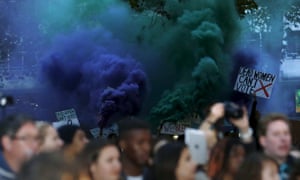
This keeps the reader entertained and interested as well as further breaking down the text. A caption underneath each picture briefly describes what's happening in the picture so even if readers hadn't read the article, they could gain a good visual understanding of the event just by looking at the picture.
Direct speech from the objects of the article also makes the article feel more informal and entertaining andthe space for comments at the bottom of the article makes the reader feel involved in the article and it's topic, which could cause them to form their own opinions and get involved in the 'conversation'.
http://www.theguardian.com/world/2015/oct/07/feminist-protesters-storm-red-carpet-at-london-premiere-of-suffragette
The article has a bold headline to attract the reader's attention and inform them of an event in a concise way that is informative but doesn't go into too much detail so the reader knows enough to be interested in the article. The subtitle 'Feminist protesters storm red carpet at London premiere of Suffragette' intrigues the reader particularly by the lexical choice of storm. The imagery of fast-paced, unstoppable action has connotations of a force of nature: something that is inevitable and can't be controlled. It also makes the reader think of a large mass of people because of the collective noun of protesters all going in the same direction with the same objective in mind.
As well as this, the contrast of protesters, who are normally considered to be more present in informal settling such as city streets, being on the red carpet suggests prestige, formality which entices the reader into reading more. There's also the stereotype of protesters being from working class backgrounds and being somewhere 'unobtainable' to stardom that is entertaining for the reader.
There is also a faded subtitle smaller than the headline which gives the reader more information about the event and encourage them to read the rest of the article: 'More than a hundred protesters jumped the barriers onto the red carpet as green and purple smoke bombs filled the air outside the Odeon cinema'. The quotation 'more than a hundred' is quite ambigious because more than a hundred could be 105 or 175 and this could exaggerate the amount of feminists protesting and therefore increases the impact of the article on the reader.
The lexical choice of 'jumped' suggests connotations of high energy, youth, revolution, for example jumping over metaphorical barriers being protesters jumping over barriers at a prestigious event.
By specifying that the smoke was green and purple has a dramatic effect on the reader, showing it's importance and informing the reader on how visually effective the smoke was.
The imagery of smoke having 'filled the air' suggests not being able to get away from the smoke in the same way protesters on the red carpet were unavoidable, shown in the quote: 'Presenter Lauren Laverne was forced to raise her voice to interview the directors on camera in front of the cinema as the activists chanted...' The focus of the article is also slightly ironic because it is giving a voice to the protesters who were trying to be silenced at the event. This is a unique angle to the story because most other newspapers would have only interviewed the actresses on the red carpet and their opinion on the situation and not spoken to the protesters, but the Guardian gives a voice to both the actresses and the feminist protesters which could be refreshing and more interesting for the reader.
The article is presented in short paragraphs which could be because as the article is online, the journalist has awareness that the reader does not have a lot of time to read long walls of text. The article is broken down so that it could be skim-read during someone's lunch break, on the tube on someone's phone etc and this means the article is accessable for anyone who can get onto their website. However, the article also caters for people with more time on their hands as key phrases such as 'Suffragette' and 'Sisters Uncut' have links to other articles on The Guardian website that are relevant to the article being read so that extra information is available if the reader wants to learn more without weighing down the article with extra unnecessary details.
There are also 4 photographs from the premiere featured in the article that attract the reader's attention because of their colour and eyecatching signs:
This keeps the reader entertained and interested as well as further breaking down the text. A caption underneath each picture briefly describes what's happening in the picture so even if readers hadn't read the article, they could gain a good visual understanding of the event just by looking at the picture.
Direct speech from the objects of the article also makes the article feel more informal and entertaining andthe space for comments at the bottom of the article makes the reader feel involved in the article and it's topic, which could cause them to form their own opinions and get involved in the 'conversation'.
Subscribe to:
Posts (Atom)