We were running. Our legs ached but we could not stop. Hearts pounding, this was the revolution and we were taking over.
"Stop the machines!"
But they are the machines, cruel metal and an autonomic voice. They argue that we're the machines now: crafted by an invisible being.
Yeah. Right.
Thursday, 30 June 2016

Monday, 9 May 2016
Commentary
In my obituary, I used the play on words 'a-bit-dreary' to indicate to the reader that the piece was going to be quite humorous and informal. This set the tone of the discourse before the reader had even read the obituary. I used the quotation from Jonathon Swift's poem 'A Satirical Elegy...'to also suggest to the reader that the piece was going to be satirical and it wasn't supposed to be taken too seriously. For the first paragraph I used factual information such as Donald Trump's birthplace and early life experiences to conform to the genre conventions of an obituary and maintain a basic level of formality, however I did use sarcastic language when referencing to the war and when quoting Donald himself ('a small loan of a million dollars') so that my personal critical view of Trump was communicated but it was not done in a way that turned it into an opinion piece rather than an obituary.
I used the unconventional simile of the dog marking his territory to spark connotations of uncleanliness, animalistic tendencies and possessiveness for the reader. The lexical choice of the adverb 'even' was used to emphasise the sarcastic tone of the piece, and the direct address of 'you' connected with the reader as it assumes that the reader has the same views as me, the writer. I also attempted to use a form of metalanguage as I mentioned the symbolism of Donald Trump owning a series of beauty pageants. I hoped that this would be thought-provoking as it causes the reader to think deeper about the meaning of this, but it could also be interpreted as darkly humorous by some readers, depending on their view of Donald Trump.
In my eulogy, I had to change the mood of the writing drastically as the two pieces were going to be so different. I began the piece by using the fact of the date, similar to in the obituary piece, to detach myself slightly from the writing and give a sense of respectful formality. I used the hyperbole of 'unimaginable strength' to stress to the reader how strongly I felt about the person being written about. This is then reiterated in the adverb 'cruelly' as it has connotations of something inhumane: something so heart-breaking that it doesn't seem right or ethical. I used the informal phrase 'to be honest' to show awareness of the eulogy needing to be read out in front of a group of people both the writer and the person being written about had connections with, rather than an obituary in a newspaper for anyone to see. This is then emphasised with the direct address of the pronoun 'you' which involves the listener in the piece and makes the eulogy feel more accessible and personal.
To touch on an anecdotal segment, I referenced Daryl being the 'little spoon' which would have been a small amount of light, humorous relief for the listeners who would most definitely be in need of it.
I also used the metaphor of unconditional love being 'locked up' inside him to give the piece a more powerful edge, as well as hint to the personality of the person being written about, as someone quite defensive and 'tough'. This contrasts with the anecdotal phase of the 'little spoon' and therefore shows dimensions to Daryl's personality. In terms of phonology, I used the plosive, alliterative sounds of 'powerful and protected' to emphasise the suggested role of Daryl within the group as someone who is constantly on guard, both literally and figuratively. I hoped that the ending of the eulogy would leave a bittersweet feeling for the listener as it mentions some things personal to Daryl: his motorbike and his crossbows.
Eulogy
On Friday 13th October, the world lost an incredible human being. Daryl Dixon brought unimaginable strength and courage to our group and it still amazes me to say that he was my partner. He was my best friend and my soulmate, so for him to be taken so cruelly from this messed up planet continues to break my heart everyday. To be honest, when I first met Daryl, I thought he hated me. His gruff and serious persona could be quite intimidating as you can probably remember, but behind the mask of aggression and fearlessness there was a sweet, loving, generous man who was the little spoon on more than one occasion.
I am so lucky to have experienced the unconditional love he had kept locked up inside him for so long and I will never forget how much he meant to me. Daryl was part of our group for six years and he was a huge part of what made this group so powerful and protected. Although he did go through some tough times, his unwavering bravery rarely faltered and he was always the one that inspired the best in those around him and encouraged them to reach their full potential. The loss of such a beautiful soul will never cease to be felt and I hope that wherever he is, he has been reunited with the love of his life (his motorbike) and an endless supply of crossbows and beer.
I am so lucky to have experienced the unconditional love he had kept locked up inside him for so long and I will never forget how much he meant to me. Daryl was part of our group for six years and he was a huge part of what made this group so powerful and protected. Although he did go through some tough times, his unwavering bravery rarely faltered and he was always the one that inspired the best in those around him and encouraged them to reach their full potential. The loss of such a beautiful soul will never cease to be felt and I hope that wherever he is, he has been reunited with the love of his life (his motorbike) and an endless supply of crossbows and beer.
Monday, 2 May 2016
A-bit-dreary for Donald Trump
The great words of Jonathon Swift spring to mind when I write that Donald J. Trump has been killed: 'The world he cumber'd long enough.'
On June 14th 1946, just a year after the war ended (so clearly God didn't think we had suffered enough), Donald Trump was born in Queens, New York City. He attended Fordham University as well as the School of Business at the University of Pennsylvania, but Trump did have to fight for a place there, having only been given 'a small loan of a million dollars' from his real estate developer father, Fred Trump.
Trump married his first wife, Czech model Ivana Zelníčková on April 7, 1977. They had three children: Donald Jr, Eric and daughter Ivanka who he famously told the world he would happily date if they were not related. He also had a daughter, Tiffany with Marla Maples and a son with Melania Knauss, Barron Trump.
Much like a dog marking his territory, Trump liked to put his name everywhere: The Trump Tower, for instance, the Trump Taj Mahal, Trump International Golf Links, Ireland. He even had his own line of coffee, fragrance, water and a board game, just in case you wanted to showcase to the world your racism, sexism and other views originating from the Dark Ages. Let's not forget his part-ownership of a series of beauty pageants, symbolising just beautifully his desire to control and possess women.
Although Trump did have considerable success with his many businesses, projects and his key role in The Apprentice USA, he had more recently charged into the limelight following his decision to run for President in 2016. His views were controversial to say the least, calling for Muslims to be banned from entering the US, saying that global warming is a governmentally-constructed myth and most Mexicans are drug dealers and rapists.
I do offer my condolences to his family and friends during this very difficult time. He was a very influential person in the world of business and has certainly made an impact on American politics. I also think it's fair to say that Donald Trump will never be forgotten.
On June 14th 1946, just a year after the war ended (so clearly God didn't think we had suffered enough), Donald Trump was born in Queens, New York City. He attended Fordham University as well as the School of Business at the University of Pennsylvania, but Trump did have to fight for a place there, having only been given 'a small loan of a million dollars' from his real estate developer father, Fred Trump.
Trump married his first wife, Czech model Ivana Zelníčková on April 7, 1977. They had three children: Donald Jr, Eric and daughter Ivanka who he famously told the world he would happily date if they were not related. He also had a daughter, Tiffany with Marla Maples and a son with Melania Knauss, Barron Trump.
Much like a dog marking his territory, Trump liked to put his name everywhere: The Trump Tower, for instance, the Trump Taj Mahal, Trump International Golf Links, Ireland. He even had his own line of coffee, fragrance, water and a board game, just in case you wanted to showcase to the world your racism, sexism and other views originating from the Dark Ages. Let's not forget his part-ownership of a series of beauty pageants, symbolising just beautifully his desire to control and possess women.
Although Trump did have considerable success with his many businesses, projects and his key role in The Apprentice USA, he had more recently charged into the limelight following his decision to run for President in 2016. His views were controversial to say the least, calling for Muslims to be banned from entering the US, saying that global warming is a governmentally-constructed myth and most Mexicans are drug dealers and rapists.
I do offer my condolences to his family and friends during this very difficult time. He was a very influential person in the world of business and has certainly made an impact on American politics. I also think it's fair to say that Donald Trump will never be forgotten.
Monday, 11 April 2016
Mock rewrite planning
The History Boys: Hector, Dorothy and the Headmaster
Intro:
Summarise the extract
Patriarchal school system symbolism
Headmaster: Short, simple declarative sentence 'I want them to do you proud'
Para 1:
Vocative of 'Headmaster', Mrs Lintott, Dorothy
Informal/formal tone of voice
Power imbalance
Para 2:
Stage directions
Shift in lexical field: Educational to social 'pizza'
Contrast of discourse with Hector and the Headmaster
Impersonal professionalism as Mrs L doesn't like the Headmaster but pretends to
Taboo language
Collective pronoun 'our fearless leader'
Hyperbole
Para 3:
Nickname vocative 'Hector'
Sarcasm, taboo language
Vocative 'darling', context of calling him out on inappropriate behaviour, patronising?
Mrs Lintott and the position of women in society
Intro:
Symbolism
Lack of female representation in the play
Mrs L as a literary tool for women in the education system and women in the 1980s
Women as a sexual conquest (Fiona)
Lexical field of war and achievement
Older women (Hector's wife) is scarcely mentioned
Women in 3 categories: Sexual object, unnecessary woman and old woman
Para 1:
Declarative sentences communicate passion and frustration
Interrogative sentence 'why do you think there are no women historians on TV?'
Irony as very few female characters in the play
The play as a 'mock society', mimicking it's prejudice
Para 2:
Key interviewing episode
Interrogative 'Dorothy, have you anything you'd like to add?'
Dorothy's experience and expertise is belittled
Low-frequency lexis 'lest' to remind all of intelligence
Para 3:
Aphorisms 'history's not such a frolic...'
Humour, hyperbole
Relatable to female audience members
Para 4:
Colloquial verb 'legged it to Dumfries'
Sudden openness is brushed aside by Hector
Women's suffering is pushed aside and belittled by men
Society's attitude towards unmarried women (kept her last name)
Heartbreaking
Intro:
Context of orphanage
Playful side to Dave and Toph's relationship as well as serious
Overstepping boundary
Repetition of 'please, don't. Please...please, please don't'
Open House as an opportunity to score
Para 1:
Dave as an authority figure
Inappropriate responsibilities for Toph eg. going to the ATM, making dinner
Very protective of Toph eg. new babysitter
Overactive imagination, blurring the lines of reality and fantasy
Asyndetic listing 'handcuffs, floorboards...' hyperawareness of the bad things that could happen
Lexical field of murder
Para 2:
Interrogative of 'were they cute?'
Dave's desperation for Toph to have a 'normal' childhood
Living vicariously through Toph?
Could be trying to extend Toph's childhood by making him relive it
Collective pronoun of 'our age'
Para 3:
Beth and Bill's 'uninvolvement' in their lives
Christmas episode, Bill's intellectually inappropriate books
Lexical field and academic register suggests Bill's lack of knowledge of children, or trying to make up for Toph's poor education/childhood?
Toph 'ingests breakfast with the cartoons', Dave 'forgets' the all-important interview
Para 4:
Dave comes across as a rather reliable narrator until we find out that Beth is actually much more involved in their lives as he leads the reader to believe
Beth's decision to get rid of their parents' ashes
Collective pronoun 'we' (don't want the ashes')
'You don't.' Personal pronoun
'You just-' aposiopesis expresses anger
Dave's 'lattice' metaphor 'the connective tissue...a vast matrix, an army, a whole, each one of us responsible for one another'
Dave's control of his parents taken away
Para 5:
Sibling relationships are important
Memoir shows the bond of siblings and how these relationships change
The gains of loss eg. Dave 'gains' Toph as his soulmate
Both have become successful , the past as a tool for success, not a barrier
Intro:
Summarise the extract
Patriarchal school system symbolism
Headmaster: Short, simple declarative sentence 'I want them to do you proud'
Para 1:
Vocative of 'Headmaster', Mrs Lintott, Dorothy
Informal/formal tone of voice
Power imbalance
Para 2:
Stage directions
Shift in lexical field: Educational to social 'pizza'
Contrast of discourse with Hector and the Headmaster
Impersonal professionalism as Mrs L doesn't like the Headmaster but pretends to
Taboo language
Collective pronoun 'our fearless leader'
Hyperbole
Para 3:
Nickname vocative 'Hector'
Sarcasm, taboo language
Vocative 'darling', context of calling him out on inappropriate behaviour, patronising?
Mrs Lintott and the position of women in society
Intro:
Symbolism
Lack of female representation in the play
Mrs L as a literary tool for women in the education system and women in the 1980s
Women as a sexual conquest (Fiona)
Lexical field of war and achievement
Older women (Hector's wife) is scarcely mentioned
Women in 3 categories: Sexual object, unnecessary woman and old woman
Para 1:
Declarative sentences communicate passion and frustration
Interrogative sentence 'why do you think there are no women historians on TV?'
Irony as very few female characters in the play
The play as a 'mock society', mimicking it's prejudice
Para 2:
Key interviewing episode
Interrogative 'Dorothy, have you anything you'd like to add?'
Dorothy's experience and expertise is belittled
Low-frequency lexis 'lest' to remind all of intelligence
Para 3:
Aphorisms 'history's not such a frolic...'
Humour, hyperbole
Relatable to female audience members
Para 4:
Colloquial verb 'legged it to Dumfries'
Sudden openness is brushed aside by Hector
Women's suffering is pushed aside and belittled by men
Society's attitude towards unmarried women (kept her last name)
Heartbreaking
Intro:
Context of orphanage
Playful side to Dave and Toph's relationship as well as serious
Overstepping boundary
Repetition of 'please, don't. Please...please, please don't'
Open House as an opportunity to score
Para 1:
Dave as an authority figure
Inappropriate responsibilities for Toph eg. going to the ATM, making dinner
Very protective of Toph eg. new babysitter
Overactive imagination, blurring the lines of reality and fantasy
Asyndetic listing 'handcuffs, floorboards...' hyperawareness of the bad things that could happen
Lexical field of murder
Para 2:
Interrogative of 'were they cute?'
Dave's desperation for Toph to have a 'normal' childhood
Living vicariously through Toph?
Could be trying to extend Toph's childhood by making him relive it
Collective pronoun of 'our age'
Para 3:
Beth and Bill's 'uninvolvement' in their lives
Christmas episode, Bill's intellectually inappropriate books
Lexical field and academic register suggests Bill's lack of knowledge of children, or trying to make up for Toph's poor education/childhood?
Toph 'ingests breakfast with the cartoons', Dave 'forgets' the all-important interview
Para 4:
Dave comes across as a rather reliable narrator until we find out that Beth is actually much more involved in their lives as he leads the reader to believe
Beth's decision to get rid of their parents' ashes
Collective pronoun 'we' (don't want the ashes')
'You don't.' Personal pronoun
'You just-' aposiopesis expresses anger
Dave's 'lattice' metaphor 'the connective tissue...a vast matrix, an army, a whole, each one of us responsible for one another'
Dave's control of his parents taken away
Para 5:
Sibling relationships are important
Memoir shows the bond of siblings and how these relationships change
The gains of loss eg. Dave 'gains' Toph as his soulmate
Both have become successful , the past as a tool for success, not a barrier
Monday, 29 February 2016
Dave and Toph's relationship
How does Eggers
present the relationship between him and Toph in Chapters 1-5 of ‘A
Heartbreaking Work of Staggering Genius’
Eggers presents the relationship between his younger self
Dave and Toph as being problematic in
the terms of Dave taking on his brother’s care at a relatively young age, but
the warmth of the brotherly love Dave also has for Toph perhaps lightens the
dysfunctional aspects of their relationship. By using imagery, metaphors and
some amount of foreshadowing in the beginning of the memoir, Eggers
communicates with the various audiences/readers both the positive, redemptive
parts of Dave and Toph’s relationship as well as the more dysfunctional
elements.
In Chapter 1, Toph is only briefly referred to as his shows
are ‘in the washing machine’. It could be interpreted that this is Eggers using
foreshadowing to suggest that Toph will soon be following in Dave’s footsteps,
as well as suggesting that Toph is not yet a large focal point in Dave’s life.
As his shows are being washed, it could suggest that Toph has been outside,
playing around and generally just behaving like a child, whereas in contrast to
this, the various audiences will also see Toph grow up very quickly as a result
of having to live with his older brother after they are orphaned. Further on in
the memoir, the readers can also see the impact of their mother’s illness and
Dave’s lack of responsibility as Toph refers to himself as being the same age as
Dave and his friends by using the collective pronoun ‘our’ (‘Oh, I thought he
was our age’). This is hugely effective on the reader as they have essentially
seen Toph grow up throughout the memoir, and this jolting realisation that Toph
has grown up too much too quickly could make certain audiences, such as
parents, understand more deeply just how Dave and Toph’s situation has affected
them.
Following on from this and Dave’s responsibility of Toph,
Dave is presented by the writer as being in control of many aspects of Toph’s
education, both formally and informally. Dave attends an ‘Open House’ at a
prospective school which shows that he does have some interest in Toph’s
education, however some audiences could argue that as Dave sees this as
opportunity to meet an ‘attractive, single mother’ and ‘score’, Dave is more
concerned about his lack of romantic relationships than the responsible
relationship he should be displaying towards Toph. As Dave teases Toph about
asking one of the mothers out, Eggers uses the repetition of ‘Please, please
don’t’ which expresses Toph pleading tone and how desperately he does not want
Dave to ask her out. But the quotation ‘Of course I won’t’ could communicate to
the reader that Dave is taking advantage of Toph’s innocence and naivety,
specifically the amount of control and influence he has over Toph’s feelings.
As Dave is both Toph’s older brother and parental guardian,
this boundary is frequently overstepped in certain parts of the memoir. However
as a memoir is in itself incredibly personal and reflective of the writer, this
shows the rawness and honesty of Eggers’ writing style although we do know from
the preface that some of the memoir has been ‘entirely reconstructed’ and many
aspects of it has been changed. During the episode where Dave playfully
pretends to fight Toph with a knife, Toph is immediately afraid and tells him
to stop, which could be a representation of the blurred lines between Dave’s
older brother role and his parental role.
From previously in the memoir, Dave is presented as a
protector of Toph, such as in the symbolism of the superhero painting on the
wall and Dave’s fear that something bad will happen to Toph. However the
audiences do see Dave behave in more of a child-like manner such as when Dave
and Toph are playing Frisbee in the park and when Dave introduces Toph to the
band ‘Journey’, saying that ‘in our new world, we will be rocking.’
By using the pronoun ‘our’ and ‘we’, Eggers reinforces the
idea that it is Dave and Toph versus the rest of the world, and that in
contrast to the beginning of the memoir, Toph is now undeniably a huge part of
Dave’s life, a part that Dave couldn’t live without. One of the themes
throughout the memoir has been Dave’s constant paranoia and anxiety that
‘people are watching him’ and that Toph will be taken away by social services.
These pronouns could highlight how isolated Dave feels, particularly as he has
very little help and support when it comes to looking after Toph: their older
sister Beth goes to college a very long way away.
The reference to a ‘new world’ emphasises to the readers how
much their lives have changed, as their whole worlds have been tipped upside
down since they were orphaned. However, the quotation ‘we will be rocking’ is
significant as it communicates Dave’s determination that despite everything,
Dave still wants both him and Toph to have a good life, one that is not
continuously overshadowed by the deaths of their parents.
Despite this, Dave is still very concerned with Toph’s
safety and wellbeing, as he appears to be very anxious over leaving Toph alone
with the new babysitter, Stephen. This could be interpreted as a contradiction
because some audiences may see Dave’s parenting skills as inadequate, so Toph
may be even safer with the babysitter than with Dave. Eggers uses the oxymoron
‘red/black worry’ in regards to his anxiety that Stephen will hurt Toph as the
colour red often has connotations of blood and violence whereas the lexical
term ‘worry’ is much less intimidating compared to, for example, ‘panic’ or
‘fear’. This could communicate to the readers how fixated Dave is on Toph being
killed and Dave’s fear of loss, possibly stemming from the loss of his parents.
This is typical of Eggers’ style as he tends to keep an underlying theme
throughout his texts, and in ‘A Heartbreaking Work of Staggering Genius’, this
theme is most notably death, loss and illness.
Sunday, 28 February 2016
Commentary
Commentary
I began my prose fantasy piece with a short, declarative
sentence to give some context to the story and also introduce the protagonist. I
knew I had to use a simple sentence in order to make the story accessible to
different audiences/readers, particularly children. I also used the past tense
of the verb ‘have’ to indicate that Ellie not believing in fairies was something
that had changed. This would make the reader intrigued into what had happened
that had made Ellie start believing in fairies. I also tried to subtly
reference another fantasy book, Alice In
Wonderland by Lewis Carroll with the imagery of Ellie falling.
To keep with the conventions of the fantasy genre, I kept
the story in the third person and past tense. The capitalisation of ‘Reality’
emphasized that the fairy world Ellie was in was very different to the one she
came from. It also suggested that Reality was a place, rather than a concept,
and this kept in line with the fantasy genre conventions as this was a world
that could never exist. I described the trees being ‘like ballet dancers’ as I
felt like this captured the beauty and grace of the fairy world as well as the elegant
structure of the trees.
In contrast to this, I wanted the secondary character, Blossom,
to be presented as more confident and grounded. Whilst the stereotypical fairy
could be considered quite fragile (‘thin film of glitter’ ‘slender’ ‘fluttered
gently’), Blossom’s personality is stronger, shown in the raising of her voice
and her ‘cheeky’ smile.
In the final paragraph, I used a lexis that was part of a
naturistic lexical field, like ‘tadpole’ and ‘lily’, that were essentially a
play on the expression ‘a tad late’. I hoped that the manipulation of these
words would emphasize how different Faeland was from Reality. The final
sentence ‘welcome home’ was used to spark the reader’s imagination about what
this could be interpreted as and the mentioning of Ellie’s grandmother could
suggest that she is also supernatural in some way.
In my blog, I used the term of endearment ‘my lovelies’ to
show a connection with the reader and make the post more personal and informal.
By saying that I knew ‘many of the readers were of school age’ I showed
awareness of my audience and who was reading my work which makes the reader
feel closer to the writer. I also used the phrase ‘if you’re anything like to
me’ to build up a trusting relationship with the audience.
I put my advice in a list to make the post more easy to
read, mainly because as the post was intended for a younger audience, I wanted
the post to be concise and get to the point quickly. As well as this, I used
the pronoun ‘you’ to talk directly to the reader and make it feel as if I was
talking specifically to each person individually. However, I was conscious of not
overusing this pronoun and coming across as patronising or condescending so I
tried to bring the focus back to me with phrases like ‘trust me’ and ‘there’s
always one kid…’ In the final paragraph, I asked the readers for their feedback
and suggestions so to not separate myself from the reader too much and keep the
lines of communication open.
Blog
Blog
Hiya my lovelies,
As requested by you guys, this is going to be a post all about my experience of college so far. I know many of you are of school age so I hope this helps you out in some way! I’ve decided to compile some of the things I’ve learnt into a list because if you’re anything like me, big walls of text aren’t fun to read.
1. The first few weeks are hell. A mess of disjointed classrooms, stairs that lead to nowhere and lots of free periods spent wandering through the café trying to find either a familiar face or just one that doesn’t look like it’s about to kill you. The only way through this is to be brave. Introduce yourself, ask for phone numbers, take photos of timetables and remember ‘What subjects do you take?’ is always a good conversation starter, unless you’ve approached a young teacher, in which case I’m sorry.
2. Your free periods are not just a good time to gather your friends together and talk about all the revision you don’t have time to do. Seriously, they’re precious and are a good opportunity to type up some notes, recap last lesson’s work or attend a workshop to ask the questions you didn’t have the chance to ask because there’s always that one kid who thinks that they’re the only person in that class who is trying to learn. Apparently they’re entitled to answering every question and not giving anyone else a chance.
3. Forget all about cliques. I know back in secondary school it was all: ‘Oh no, only those people sit on that table’ and ‘Oh, we can’t hang out with them because they’re…’ but seriously, in college it’s a different story. If someone is in your class, if someone vaguely knows one of your friends, if someone is sat on their own, if there’s a group of friends you want to talk to…then just do it. You’ll find yourself making loads of really different and interesting friends, and trust me, that’s a good thing.
4. Go out more. If you’re invited to something, just go for it. You might only know one person, you might know many, you might not even like the activity, but the chances are it’ll be a laugh. You’ll meet new people, you’ll spend time with people who think you’re great- what’s not to love? Even if it means going to some crappy trampoline ‘disco’ on a Friday night and you’re surrounded by little kids (who are clearly judging you), something really awesome might come out of it, you never know.
5. But saying that, remember why you’re there: to get good grades, to learn about subjects that actually interest you and get a bit more independence. Of course it’s fun to have a much more exciting social life than you did in secondary school (I hope…), but your grades must come first in any situation that doesn’t jeopardise your mental health. So this means you can probably skip seeing your friend for 10 minutes in order to finish off an English essay, but you should definitely remember that there is a life to be had outside of lessons and work.
Thanks so much for reading this guys, let me know if you have any suggestions for my next blog post!
Fantasy
Fantasy piece
Ellie had never believed in fairies. The tooth fairy, sure,
until she was 7 or 8 and she saw her mother sneak into her room with a £1 coin
and a note in her hand. But never as real, actually living creatures. That was
until last Summer, when she somehow stumbled into a whole other world whilst in
her grandmother’s garden.
It had all happened so fast. All she remembers of before was
digging around some mushrooms, and then suddenly she was falling, faster and
faster like when you think you’re asleep but are then jerked awake. Except she
didn’t wake up: this wasn’t a dream.
When she finally hit the bottom, she couldn’t believe her
eyes. Everywhere there was colour, some she recognised, others she didn’t. The
grass smelt like sweets and everything was coated in a thin film of glitter.
Looking at her fingers in disbelief, she could see the pale green sparkles on
her fingertips. Walking felt lighter than it did in Reality, as if gravity wasn’t
as powerful somehow. When she jumped, Ellie hovered for a good 5 and a half
seconds before slowly sinking back onto the ground. All around her there were
trees, towering and spiralling upwards. Some were thin and had long, stretched
out branches that reminded Ellie of being a ballet dancer and others were tall,
great hunks of bark and leaves. When she rested against a tree, a small blue
bird hopped onto her hand and peered at her with beady, unblinking eyes. The
bird had been knitted so it was made out of the softest wool imaginable and it’s
eyes were buttons with a perfect cross stitch holding them together.
“That’s Feather. Sweet, isn’t she?” A voice said from behind
her, making Ellie jump. The bird flew away, ascending into the purple-pink sky.
There was a girl with long red hair smiling at her gently, swinging her arm
from one of the branches and wrapping her slender body around the trunk of the
tree. She had startlingly green eyes and glowing pale skin spattered with
freckles, but what took Ellie aback the most was her gorgeous wings that
fluttered gently. They were just like in the fairytale stories, shining and
glittering in the sunlight. You could see flecks of every colour dance in her
aura.
“Who are you?” Ellie breathed, too in awe to pretend she
wasn’t even slightly startled. The girl grinned cheekily.
“I’m Blossom, the only one around here who knows how to talk
to strangers apparently. Don’t worry, the other fairies are just a bit shy.
They say I’m too talkative but I guess it comes in handy in times like this.”
She raised her voice at the end, obviously laughing.
“Fairies?” A lump formed in Ellie’s throat. Was this it? Was
everything she told as a child…true?
“Oh, come on, Ellie! You think these wings are just for
decoration?” Blossom reached behind and tugged at the top of one of her wings. It
lit up as she did so.
“How does she know my
name?” Ellie thought to herself as she followed behind Blossom, who seemed
to be leading her towards a river.
“I know everything, silly! You’re only a tadpole late: your
grandmother said you would be here for around Lily ‘o’ clock but that’s okay.
You’re here now and that’s what matters! So Ellie, this is Faeland. Welcome
home.”
Tuesday, 26 January 2016
Representation of women in AHWOSG
-'If the star of the something-like-a-date expresses any reservations about having Toph along, she is clearly a very bad person'
Dave has impossibly high standards for the women in his life. If they do not fit his exact, cookie-cutter shape of what they should be like, how they should feel, how they should behave, they are more than just inferior to him- they are bad people altogether and don't deserve to be in his life.
-'It means that I like her less...she is misguided, self-centered and also a bad person...that's not her place and there's no coming out of that alive'
Dave wants women to say in a certain space, somewhere he can be detached from them. He seems to view women as not having any natural curiosities or feelings, and that anything he doesn't approve of is rude and unacceptable.
-'The 29 year old, an actual woman-woman'
Hierarchy of women. Concept of 'real' women and 'fake' women. Women aren't 'real' women until they are mature and perhaps are more likely to be manipulated by him, as he thinks he knows what's going on inside every woman's head. Ageism.
-'If she would be wrinkled, prunelike, sagging...I was ready to be horrified...if I had to touch her pimpled or varicose flesh'
Naive, childish, immature. Very sexist and ageist as he assumes that anyone above his own age is old, even though the woman he is dating is only 29. Extremely inexperienced and narrow-minded when it comes to the female body.
-'Marny's breasts...are kind of uneven...June looks normal.'
Wants a woman with a 'perfect' (not real) body. Lexical choice of 'normal' shows how messed up Dave's idea is of woman as he has this ideal image in his head of what a woman's breasts should look like, and anything that is not this perfect image is abnormal, weird or disgusting.
-'She is my mother, my girlfriend, my wife.'
Reminds me of the anti-rape campaign that was to do with 'how would you feel if that was your mother? Your wife? etc' Women are only important and matter if they have some relationship with you.
-'I want Toph to be her friend and make her happy'
A girl can only happy if she has a friend who is a boy/relationship with a boy. As the girl is slightly on the larger side then it is presumed that she is unhappy.
-'I was looking to score. I expected flirting. I expected attractive single mothers.'
Thinks very highly of himself. Presumes single mothers to be attractive and desperate.
Dave has impossibly high standards for the women in his life. If they do not fit his exact, cookie-cutter shape of what they should be like, how they should feel, how they should behave, they are more than just inferior to him- they are bad people altogether and don't deserve to be in his life.
-'It means that I like her less...she is misguided, self-centered and also a bad person...that's not her place and there's no coming out of that alive'
Dave wants women to say in a certain space, somewhere he can be detached from them. He seems to view women as not having any natural curiosities or feelings, and that anything he doesn't approve of is rude and unacceptable.
-'The 29 year old, an actual woman-woman'
Hierarchy of women. Concept of 'real' women and 'fake' women. Women aren't 'real' women until they are mature and perhaps are more likely to be manipulated by him, as he thinks he knows what's going on inside every woman's head. Ageism.
-'If she would be wrinkled, prunelike, sagging...I was ready to be horrified...if I had to touch her pimpled or varicose flesh'
Naive, childish, immature. Very sexist and ageist as he assumes that anyone above his own age is old, even though the woman he is dating is only 29. Extremely inexperienced and narrow-minded when it comes to the female body.
-'Marny's breasts...are kind of uneven...June looks normal.'
Wants a woman with a 'perfect' (not real) body. Lexical choice of 'normal' shows how messed up Dave's idea is of woman as he has this ideal image in his head of what a woman's breasts should look like, and anything that is not this perfect image is abnormal, weird or disgusting.
-'She is my mother, my girlfriend, my wife.'
Reminds me of the anti-rape campaign that was to do with 'how would you feel if that was your mother? Your wife? etc' Women are only important and matter if they have some relationship with you.
-'I want Toph to be her friend and make her happy'
A girl can only happy if she has a friend who is a boy/relationship with a boy. As the girl is slightly on the larger side then it is presumed that she is unhappy.
-'I was looking to score. I expected flirting. I expected attractive single mothers.'
Thinks very highly of himself. Presumes single mothers to be attractive and desperate.
Sunday, 24 January 2016
Notes: pg 166-182 (AHWOSG)
'We're all lying'
-Collective pronoun shows certainty of others around him, he believes that everyone feels the same was as he does
-Present tense of 'ongoing', suggests he is a deceiving person
-Short sentence, statement/declarative
'They have tattoos before everyone has tattoos...no cars that are not old cars...'
-Culture shock?
-Feels that he physically looks different from everyone else
-Confusion/awe
'We say nothing and complain little...we have to work 18 hours a day...we're in a certain place'
-Feels that he needs to meet high standards in order to really 'work'
-Very submissive, he's being manipulated, brainwashed?
-Blends in completely, not seen as an individual, similar to when he moved into a diverse neighbourhood
'We want them doing things that we will find interesting'
-Demanding
-Focus on 'we' shows that he's slowly becoming a part of a collective
-Selfish, manipulative, corporate
'We are obsessed with seeming diverse'
-Very racist
-Token minority individuals used to make his company look better
-Careless wording, obviously lying because of 'seeming'. Aware that it's all a lie.
-'June is our black friend....' Places huge weight on the colour of someone's skin.
-Collective pronoun shows certainty of others around him, he believes that everyone feels the same was as he does
-Present tense of 'ongoing', suggests he is a deceiving person
-Short sentence, statement/declarative
'They have tattoos before everyone has tattoos...no cars that are not old cars...'
-Culture shock?
-Feels that he physically looks different from everyone else
-Confusion/awe
'We say nothing and complain little...we have to work 18 hours a day...we're in a certain place'
-Feels that he needs to meet high standards in order to really 'work'
-Very submissive, he's being manipulated, brainwashed?
-Blends in completely, not seen as an individual, similar to when he moved into a diverse neighbourhood
'We want them doing things that we will find interesting'
-Demanding
-Focus on 'we' shows that he's slowly becoming a part of a collective
-Selfish, manipulative, corporate
'We are obsessed with seeming diverse'
-Very racist
-Token minority individuals used to make his company look better
-Careless wording, obviously lying because of 'seeming'. Aware that it's all a lie.
-'June is our black friend....' Places huge weight on the colour of someone's skin.
'Home' essay (AHWOSG)
The first presentation we get of home in 'A Heartbreaking Work of Staggering Genius' is the metaphor of the house being a 'factory'. Eggers used this to show that Dave was detached from his home environment and that he views his home as an artificial production line. This could be because of his mother's illness: he views it as more of a hospital setting with people going in and out. However in this case, his mother barely leaves the house so it shows that she's not getting better.
We know this from the quotation 'there was a time when she was still up and about...running errands'. This shows stagnation and that his mother's progress towards health has come to a stand still. Everything is decaying around him because his mother can no longer clean or maintain the house the was she used to. Just as her body is decaying, so is the house.
Eggers uses the quotation '...inviting everyone to come and watch us in the middle of our disintegration' to show how protective Dave feels toward the house, as if it's his personal place to break down, The idea of having a party at home feels odd because for him these concepts are juxtaposed: a party is seen as fun, vibrant and full of life whereas his home feels like a 'factory', somewhere grey and dull and drained of energy. This links with Dave's uncomfortable feeling about 'everyone knowing' his family's issues because he doesn't want to invite strangers or friends into somewhere he doesn't feel they belong: his home. For Dave, there is both a physical and emotional barrier between him and the people outside. The physical barrier is the house's walls and the emotional barrier is the one he puts there himself, shown in the quotation: 'I....have developed elaborate fantasies for those who would see...our situation (as) gossip fodder.' The lexical choice of 'fodder' has connotations of a farm and animals, suggesting that Eggers saw his neighbours and anyone outside of his family as beasts waiting to feast on his bad news/situation. He uses his home to keep them away, even stating that he is 'not a proponent of the curtains being open'. This shows that he will go to desperate measures to stop anyone from seeing the truth about his home life.
The sublet that Dave describes can be contrasted with the family home, as he wants to be somewhere small in a place that is rather big eg. California. In his home, he is considered the 'big' one in some place small, which is the family home. Dave has to be Toph's big brother as well as his guardian and he has to be his mother's carer and look after her. Because of this he feels 'seen' by everyone around him, shown when Eggers uses the repetition of 'everybody knows'. Dave feels like he's constantly being watched, talked about and intruded upon because of his situation, and he wants to his home to be somewhere quite detached, temporary ('sublet') and freeing, shown in the description of the scenery around him, for example the hilltops, the sky and the sea. Later on in the memoir when Dave is searching for a new house, it's clear that he can't afford the house he really wants and this is upsetting for him as he sees home as such an important and influential part of his life. He can't afford anywhere with even a bathtub or doors, let alone a beautiful backdrop to his story. It's important to mention that having doors would be essential for Dave as he is so guarded about his home life.
On page 61, Eggers uses the exclamation marks in the living arrangements description to show Dave's excitement, youthfulness and naivety. He's almost parodying his past self by using short, exclamatory sentences that make him sound innocent and child-like. The fact that the emphasis has been placed on everything being shared, 'like a commune', shows how sick Dave is of all the constant responsibility and pressure. It shows that he feels isolated and detached from everyone else around him, and that he would appreciate being able to share his struggles to keep on top of everything he currently has control over.
When him and Toph do get their own place, Dave is adamant that Toph helps with the chores so he is not alone in doing the housework. As Eggers compares this to college, it is further reinstated that Dave wants to go back to the way he feels he should be in his early 20s: playful and not taking anything too seriously, but he is also cynical and bitter about the way he acted before he had to take on a more mature role within in the family. This is supported by the use of the diagram on page 62, as the floor plan, although it shows that Dave has awareness of the practicalities of owning a house, it indicates the perfect area to slide in socks which reminds the reader how young Dave really is and perhaps makes us feel more protective towards him. When the entropy of living conditions is made clear on page 82, Eggers uses the child-like lexical choices of 'call me bad names' to show Dave's true innocence and fragility. This has connotations of bullying, which is probably what Eggers was trying to convey: Dave feels bullied by the outside world, made to feel small by the people around him.
When Dave and Toph finally do get a house, they are surrounded by what could be considered minority neighbours. For once they are not the topic of conversation because there are so many more people around them who have their own stories to tell. They are not unusual, or pitied upon, or felt sorry for, because in this neighbourhood they are not special at all: they blend in with everyone else.
We know this from the quotation 'there was a time when she was still up and about...running errands'. This shows stagnation and that his mother's progress towards health has come to a stand still. Everything is decaying around him because his mother can no longer clean or maintain the house the was she used to. Just as her body is decaying, so is the house.
Eggers uses the quotation '...inviting everyone to come and watch us in the middle of our disintegration' to show how protective Dave feels toward the house, as if it's his personal place to break down, The idea of having a party at home feels odd because for him these concepts are juxtaposed: a party is seen as fun, vibrant and full of life whereas his home feels like a 'factory', somewhere grey and dull and drained of energy. This links with Dave's uncomfortable feeling about 'everyone knowing' his family's issues because he doesn't want to invite strangers or friends into somewhere he doesn't feel they belong: his home. For Dave, there is both a physical and emotional barrier between him and the people outside. The physical barrier is the house's walls and the emotional barrier is the one he puts there himself, shown in the quotation: 'I....have developed elaborate fantasies for those who would see...our situation (as) gossip fodder.' The lexical choice of 'fodder' has connotations of a farm and animals, suggesting that Eggers saw his neighbours and anyone outside of his family as beasts waiting to feast on his bad news/situation. He uses his home to keep them away, even stating that he is 'not a proponent of the curtains being open'. This shows that he will go to desperate measures to stop anyone from seeing the truth about his home life.
The sublet that Dave describes can be contrasted with the family home, as he wants to be somewhere small in a place that is rather big eg. California. In his home, he is considered the 'big' one in some place small, which is the family home. Dave has to be Toph's big brother as well as his guardian and he has to be his mother's carer and look after her. Because of this he feels 'seen' by everyone around him, shown when Eggers uses the repetition of 'everybody knows'. Dave feels like he's constantly being watched, talked about and intruded upon because of his situation, and he wants to his home to be somewhere quite detached, temporary ('sublet') and freeing, shown in the description of the scenery around him, for example the hilltops, the sky and the sea. Later on in the memoir when Dave is searching for a new house, it's clear that he can't afford the house he really wants and this is upsetting for him as he sees home as such an important and influential part of his life. He can't afford anywhere with even a bathtub or doors, let alone a beautiful backdrop to his story. It's important to mention that having doors would be essential for Dave as he is so guarded about his home life.
On page 61, Eggers uses the exclamation marks in the living arrangements description to show Dave's excitement, youthfulness and naivety. He's almost parodying his past self by using short, exclamatory sentences that make him sound innocent and child-like. The fact that the emphasis has been placed on everything being shared, 'like a commune', shows how sick Dave is of all the constant responsibility and pressure. It shows that he feels isolated and detached from everyone else around him, and that he would appreciate being able to share his struggles to keep on top of everything he currently has control over.
When him and Toph do get their own place, Dave is adamant that Toph helps with the chores so he is not alone in doing the housework. As Eggers compares this to college, it is further reinstated that Dave wants to go back to the way he feels he should be in his early 20s: playful and not taking anything too seriously, but he is also cynical and bitter about the way he acted before he had to take on a more mature role within in the family. This is supported by the use of the diagram on page 62, as the floor plan, although it shows that Dave has awareness of the practicalities of owning a house, it indicates the perfect area to slide in socks which reminds the reader how young Dave really is and perhaps makes us feel more protective towards him. When the entropy of living conditions is made clear on page 82, Eggers uses the child-like lexical choices of 'call me bad names' to show Dave's true innocence and fragility. This has connotations of bullying, which is probably what Eggers was trying to convey: Dave feels bullied by the outside world, made to feel small by the people around him.
When Dave and Toph finally do get a house, they are surrounded by what could be considered minority neighbours. For once they are not the topic of conversation because there are so many more people around them who have their own stories to tell. They are not unusual, or pitied upon, or felt sorry for, because in this neighbourhood they are not special at all: they blend in with everyone else.
Saturday, 21 November 2015
PEE paragraph on transcript and the Drummer Hodge scene
Transcript
The teacher uses interrogatives such as 'so what is the main point of the poem?' to set the agenda of the class discussion and make the class think. The lexical choice of 'so' focuses the students and adds to the fact that she wants them to come to a conclusion. Interrogatives are also used in latched talk: 'it's a kind of, of amorous play, isn't it?' 'Amorous?' 'Yes, amorous play' which shows the asymmetrical power between the student and the teacher. The teacher has more airtime which shows her expertise and makes her sound more knowledgeable. The interrogatives are also used to apply constraints to the discussion: 'is that a threat?' to remind the student, Alex, that they're in a classroom and she as the teacher has control over him. This asymmetrical power is then challenged using another interrogative 'what if I don't answer?' which shows sarcasm and a certain amount of disrespect for the teacher's authority.
The Drummer Hodge scene
The techniques used during this scene show how Hector and Posner are both very isolated and lonely characters. The use of latched talk makes Posner sound eager: 'How old was he?' 'If he's a drummer...' 'No. Hardy.' and shows that the poem has made an impact on him. As well as this, the adjacency pair of 'not being in the swim. Can you see that?' 'Yes, sir. I felt that a bit.' shows that Posner feels comfortable with Hector and this is also a co-operative overlap. However, Hector quickly puts constraints on this situation as he says 'shall we just have the last verse again and I'll let you go.' which reminds both the characters and the audience that they're in a professional, classroom setting and that there is an asymmetrical power between the two characters. Hector shows his expertise through utterances like 'it's a turn of phrase he has bequeathed to Larkin, who liked Hardy apparently' which Bennett uses to show how knowledgeable, fluent and passionate he is. This is also shown in the longer airtime Hector has compared to Posner: the audience can tell that this is an important scene between the characters and that Posner is learning something from Hector who is shown as being wise but vulnerable,
The teacher uses interrogatives such as 'so what is the main point of the poem?' to set the agenda of the class discussion and make the class think. The lexical choice of 'so' focuses the students and adds to the fact that she wants them to come to a conclusion. Interrogatives are also used in latched talk: 'it's a kind of, of amorous play, isn't it?' 'Amorous?' 'Yes, amorous play' which shows the asymmetrical power between the student and the teacher. The teacher has more airtime which shows her expertise and makes her sound more knowledgeable. The interrogatives are also used to apply constraints to the discussion: 'is that a threat?' to remind the student, Alex, that they're in a classroom and she as the teacher has control over him. This asymmetrical power is then challenged using another interrogative 'what if I don't answer?' which shows sarcasm and a certain amount of disrespect for the teacher's authority.
The Drummer Hodge scene
The techniques used during this scene show how Hector and Posner are both very isolated and lonely characters. The use of latched talk makes Posner sound eager: 'How old was he?' 'If he's a drummer...' 'No. Hardy.' and shows that the poem has made an impact on him. As well as this, the adjacency pair of 'not being in the swim. Can you see that?' 'Yes, sir. I felt that a bit.' shows that Posner feels comfortable with Hector and this is also a co-operative overlap. However, Hector quickly puts constraints on this situation as he says 'shall we just have the last verse again and I'll let you go.' which reminds both the characters and the audience that they're in a professional, classroom setting and that there is an asymmetrical power between the two characters. Hector shows his expertise through utterances like 'it's a turn of phrase he has bequeathed to Larkin, who liked Hardy apparently' which Bennett uses to show how knowledgeable, fluent and passionate he is. This is also shown in the longer airtime Hector has compared to Posner: the audience can tell that this is an important scene between the characters and that Posner is learning something from Hector who is shown as being wise but vulnerable,
Wednesday, 18 November 2015
Donnie Darko film review
Donnie Darko film review
Considered a cult classic by many, misunderstood by others, there’s
no arguing that Donnie Darko (2001) is one hell of a film. Is it a horror film?
Is it a psychological thriller? Critics have been trying to label this film ever
since its release but it is difficult. The film does deal with some quite
horrific ideals but it’s not scary in the sense of jump scares and popcorn
flying out of buckets. With its irresistible misery and twisted plotline, it’s
a film that can be rewatched over and over again whilst still finding more
things to love and understand. The casting choices are great, with Jake
Gyllenhaal taking the title role as a schizophrenic teenager who is told by a
grotesque-looking rabbit (called Frank, naturally) that the world is going to
end in 28 days. As the film progresses, you can see Donnie gradually becoming
more disturbed and him trying to understand the meaning behind his troubling
visions. Not for the faint hearted, his journey ends up becoming a chilling
experience for both Donnie and the audience.
Richard Kelly (director) expertly uses the artificial exploitation
of the American-dream lifestyle to emphasize Donnie’s inner turmoil: houses
with white picket fences and carefully mown lawns contrast perfectly with Donnie’s
unnerving hallucinations and a darker, more twisted side to time travel. There
is a kind of beauty in nothing making sense at first glance, but by the end of
the film, it all clicks into place. In particular, some of the more distressing
scenes are filmed in such a way that the audience feels like they’re
hallucinating and this adds to the dissociation and oppressive intensity of the
film. It would also be fitting to mention the incredible choice of music to
accompany the film. In fact, I would argue that in many of the scenes in the
film, it’s the chilling music that makes the atmosphere so downright creepy.
What’s so enthralling about this film is the way it manages
to combine so many different topics whilst still having a distinct purpose. Kelly
manages to combine romance, reality, the future, time travel, mental illness
and horror into nearly every scene which is important and necessary for the
conclusion of the film to be understood. This perhaps explains why it has so
much of a cult following and why it continues to maintain such a respected
cinematic status. Despite its somewhat puzzling ending, this doesn’t take away
from the rest of the film; it instead adds to it and makes you want to watch
the whole thing again: the definition of a brilliant film. You are left with so
many questions that all you can do is sit in silence as ‘Mad World’ plays in
the finishing sequence and press replay. Overall it’s a film that will stay
with you long after the final credits roll. Donnie Darko has a concept and plot
surrounding it that is so unique I doubt you will ever see anything like it
again.
Tuesday, 17 November 2015
Discuss how Irwin and Posner's relationship is presented in this exchange
Discuss how Irwin
and Posner’s relationship is presented in this exchange
Throughout this discourse, we see how Irwin has impacted on
Posner’s life and how his teaching has affected his future. The audience sees
Irwin as a successful historian presenting on the BBC using lots of elevated
lexis (‘venerate supine antiquity’)to show his high intelligence contrasted
with Posner’s failure in life after leaving Cambridge unable to cope and being
stuck with a lot of regret and cynicism, arguably as a result of Irwin’s
attitude to the boys’ learning.
Bennett uses the interrogative to express Irwin’s curiosity
and disbelief in Posner, saying ‘what happened in Oxford? …And did you write it
yourself?” to highlight Irwin’s intrigue into what has become Posner’s life.
This could come across as being quite genuine, but at the beginning of the
scene Irwin has already stated that ‘disability brings with it an assumption of
sincerity’ which suggests that his relationship with Posner is quite strained
and not as it seems from the very beginning. This is also supported by Bennett
having both characters use ellipses to show that the characters are treading
carefully in their dialogue and are suspicious of each other, which Irwin is
proved right to be as the audience finds out later in the scene. It is revealed
in his sudden urgency (‘tell me, sir. I need to know’) that Posner is recording
their conversation in order to catch Irwin out and sell the story of him and Dakin’s
presumed inappropriate relationship for money.
The use of the declarative and simple sentences also makes
the atmosphere between Irwin and Posner feel tense and uncomfortable. Posner
says things in a very short, clipped manner such as ‘I have a counsellor... It
didn’t work out…you’re a celebrity’ which gives the impression that there is a
lot of subtext: things aren’t being said and there is no room for argument.
Compared to the Posner we see in earlier scenes: shy, eager to please, sensitive…it
makes him come across as having this cynical confidence which is emotionally
distressing for the audience to see. Along with this, Irwin’s use of asyndetic
listing (‘Saner, wiser, more rational…’) puts across that he doesn’t have time
for Posner, that he is trying to rush their discourse and that full explanation
of what Posner is asking isn’t worth his time, which is an entirely different
story to the one we saw when Posner admitted to Irwin that he thought he might
be homosexual and Irwin was a lot more understanding.
In addition, Posner seems to feel more equal to Irwin now he
is 5 years older, although he does still resort to using the vocative ‘Sir’ to signify
that he’s not all grown up yet. Their relationship is still teacher-student in
Posner’s eyes and this is supported by Irwin refusing to sign his book to
David, which is Posner’s first name. As Irwin only called Posner by his last
name, it shows that Irwin doesn’t really respect him as an older adult now and
still sees him as the struggling, sensitive teenage boy he taught years ago. As
well as this, Irwin uses taboo language (‘I wasn’t like Hector. Now fuck off’)
towards Posner which also shows that he doesn’t have a lot of respect for him. Their
relationship is clearly a complicated one, tainted with blame and a history
that has already damaged Posner and could damage Irwin in the future.
Sunday, 18 October 2015
Dystopian novel opening
‘Write the opening to a dystopian novel where you imagine
your school many years in the future’
It wasn’t a surprise to anyone when it happened. The world
had slowly become so artificial that it was almost like natural progression for
students to not only be graded on their intelligence but also on their looks.
It started with the appearance ratings from 1 to 10 whispered between friends
and giggled over. This led to modelling, beauty pageants and apps that allowed
you to publicly rate people that you’ve dated. Until society reached a point where just as letters
were stamped onto our brain capacity, numbers were burned onto our skin.
When I went back to school a few days ago for research
purposes, the outside hadn’t changed much, but the atmosphere was completely
different. I felt like I was being judged the second I walked through those
towering black gates, that eyes were scanning me from my head to my toes in
order to place me in some messed up social ranking. Immediately I felt
extremely self-conscious and wrapped my arms around my waist as if to hide away
people’s looks.
But what shocked me the most was how students were taught. Lessons
like PE and PSHE were now more like ‘Muscle Building’ and ‘How to wear make-up’
lessons and alongside students’ target exam grade was a target appearance grade.
As well as this, some teachers have been replaced by YouTube videos and online
lessons. This shocked me in a way that I hadn’t expected, because the concept
of being judged on your appearance would have caused riots in 2015, but here in
2025 it doesn’t seem odd at all, as if it had always happened. Maybe it had,
and we’d just never noticed it before.
Friday, 16 October 2015
Dystopian school ideas
- Schools will provide a much wider set of services to the local community, providing a hub of shared facilities to cater for the needs of the community from social services and support through to healthcare and faith centres.
- Students will learn at times most convenient for them. (Yet some attendance at an actual school will be required to help students develop appropriate social skills)
- Children using spread sheets to track their height and weight through school life. Not just tracking behaviour and educational goals, schooled to look a certain way?
- Robot teachers allow teachers to teach at home whilst their students are in the classroom (no supply teachers)
- No lessons, just teachers available and specific time dedicated to lessons via the internet
Thursday, 15 October 2015
TV Documentary notes
10 Days in North Korea
- Statement sentences
- Informs audience on context, gives North Korean back story
- Commentary
- "..." says....
- Explains what's being shown ('this statue symbolizes...')
- Acts as a translator for the audience
- Let's the camera and interviewees do the talking
- "That's what we were told by...he'll accompany us throughout this trip..."
- "Our visit ends in..." like a tour guide
- Formal, low frequency lexical choices eg. embewed
- Describes visual scenes in great detail: '...run down but wide, spectacularly clean and practically empty road...'
- "It is said that..."
- Dramatic language 'striking', lots of statistics and comparisons with other countries, emphasis on difference
- 'He's talking about...'
- 'It promotes...or rather...'
- Awareness of other perspectives, 'although it seems dangerous to foreigners', unbiased
- Based on factual evidence and observation
- After possibly shocking phrases 'receiving food rations', there is a pause in the voice over to let that information sink in
Thursday, 8 October 2015
How does the article inform and entertain its reader?
Feminist protesters storm red carpet at London premiere of Suffragette'- The Guardian, 07/10/15
http://www.theguardian.com/world/2015/oct/07/feminist-protesters-storm-red-carpet-at-london-premiere-of-suffragette
The article has a bold headline to attract the reader's attention and inform them of an event in a concise way that is informative but doesn't go into too much detail so the reader knows enough to be interested in the article. The subtitle 'Feminist protesters storm red carpet at London premiere of Suffragette' intrigues the reader particularly by the lexical choice of storm. The imagery of fast-paced, unstoppable action has connotations of a force of nature: something that is inevitable and can't be controlled. It also makes the reader think of a large mass of people because of the collective noun of protesters all going in the same direction with the same objective in mind.
As well as this, the contrast of protesters, who are normally considered to be more present in informal settling such as city streets, being on the red carpet suggests prestige, formality which entices the reader into reading more. There's also the stereotype of protesters being from working class backgrounds and being somewhere 'unobtainable' to stardom that is entertaining for the reader.
There is also a faded subtitle smaller than the headline which gives the reader more information about the event and encourage them to read the rest of the article: 'More than a hundred protesters jumped the barriers onto the red carpet as green and purple smoke bombs filled the air outside the Odeon cinema'. The quotation 'more than a hundred' is quite ambigious because more than a hundred could be 105 or 175 and this could exaggerate the amount of feminists protesting and therefore increases the impact of the article on the reader.
The lexical choice of 'jumped' suggests connotations of high energy, youth, revolution, for example jumping over metaphorical barriers being protesters jumping over barriers at a prestigious event.
By specifying that the smoke was green and purple has a dramatic effect on the reader, showing it's importance and informing the reader on how visually effective the smoke was.
The imagery of smoke having 'filled the air' suggests not being able to get away from the smoke in the same way protesters on the red carpet were unavoidable, shown in the quote: 'Presenter Lauren Laverne was forced to raise her voice to interview the directors on camera in front of the cinema as the activists chanted...' The focus of the article is also slightly ironic because it is giving a voice to the protesters who were trying to be silenced at the event. This is a unique angle to the story because most other newspapers would have only interviewed the actresses on the red carpet and their opinion on the situation and not spoken to the protesters, but the Guardian gives a voice to both the actresses and the feminist protesters which could be refreshing and more interesting for the reader.
The article is presented in short paragraphs which could be because as the article is online, the journalist has awareness that the reader does not have a lot of time to read long walls of text. The article is broken down so that it could be skim-read during someone's lunch break, on the tube on someone's phone etc and this means the article is accessable for anyone who can get onto their website. However, the article also caters for people with more time on their hands as key phrases such as 'Suffragette' and 'Sisters Uncut' have links to other articles on The Guardian website that are relevant to the article being read so that extra information is available if the reader wants to learn more without weighing down the article with extra unnecessary details.
There are also 4 photographs from the premiere featured in the article that attract the reader's attention because of their colour and eyecatching signs:
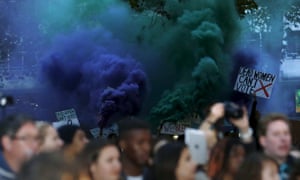
This keeps the reader entertained and interested as well as further breaking down the text. A caption underneath each picture briefly describes what's happening in the picture so even if readers hadn't read the article, they could gain a good visual understanding of the event just by looking at the picture.
Direct speech from the objects of the article also makes the article feel more informal and entertaining andthe space for comments at the bottom of the article makes the reader feel involved in the article and it's topic, which could cause them to form their own opinions and get involved in the 'conversation'.
http://www.theguardian.com/world/2015/oct/07/feminist-protesters-storm-red-carpet-at-london-premiere-of-suffragette
The article has a bold headline to attract the reader's attention and inform them of an event in a concise way that is informative but doesn't go into too much detail so the reader knows enough to be interested in the article. The subtitle 'Feminist protesters storm red carpet at London premiere of Suffragette' intrigues the reader particularly by the lexical choice of storm. The imagery of fast-paced, unstoppable action has connotations of a force of nature: something that is inevitable and can't be controlled. It also makes the reader think of a large mass of people because of the collective noun of protesters all going in the same direction with the same objective in mind.
As well as this, the contrast of protesters, who are normally considered to be more present in informal settling such as city streets, being on the red carpet suggests prestige, formality which entices the reader into reading more. There's also the stereotype of protesters being from working class backgrounds and being somewhere 'unobtainable' to stardom that is entertaining for the reader.
There is also a faded subtitle smaller than the headline which gives the reader more information about the event and encourage them to read the rest of the article: 'More than a hundred protesters jumped the barriers onto the red carpet as green and purple smoke bombs filled the air outside the Odeon cinema'. The quotation 'more than a hundred' is quite ambigious because more than a hundred could be 105 or 175 and this could exaggerate the amount of feminists protesting and therefore increases the impact of the article on the reader.
The lexical choice of 'jumped' suggests connotations of high energy, youth, revolution, for example jumping over metaphorical barriers being protesters jumping over barriers at a prestigious event.
By specifying that the smoke was green and purple has a dramatic effect on the reader, showing it's importance and informing the reader on how visually effective the smoke was.
The imagery of smoke having 'filled the air' suggests not being able to get away from the smoke in the same way protesters on the red carpet were unavoidable, shown in the quote: 'Presenter Lauren Laverne was forced to raise her voice to interview the directors on camera in front of the cinema as the activists chanted...' The focus of the article is also slightly ironic because it is giving a voice to the protesters who were trying to be silenced at the event. This is a unique angle to the story because most other newspapers would have only interviewed the actresses on the red carpet and their opinion on the situation and not spoken to the protesters, but the Guardian gives a voice to both the actresses and the feminist protesters which could be refreshing and more interesting for the reader.
The article is presented in short paragraphs which could be because as the article is online, the journalist has awareness that the reader does not have a lot of time to read long walls of text. The article is broken down so that it could be skim-read during someone's lunch break, on the tube on someone's phone etc and this means the article is accessable for anyone who can get onto their website. However, the article also caters for people with more time on their hands as key phrases such as 'Suffragette' and 'Sisters Uncut' have links to other articles on The Guardian website that are relevant to the article being read so that extra information is available if the reader wants to learn more without weighing down the article with extra unnecessary details.
There are also 4 photographs from the premiere featured in the article that attract the reader's attention because of their colour and eyecatching signs:
This keeps the reader entertained and interested as well as further breaking down the text. A caption underneath each picture briefly describes what's happening in the picture so even if readers hadn't read the article, they could gain a good visual understanding of the event just by looking at the picture.
Direct speech from the objects of the article also makes the article feel more informal and entertaining andthe space for comments at the bottom of the article makes the reader feel involved in the article and it's topic, which could cause them to form their own opinions and get involved in the 'conversation'.
Key genre features in a newspaper article
'Feminist protesters storm red carpet at London premiere of Suffragette'- The Guardian, 07/10/15
http://www.theguardian.com/world/2015/oct/07/feminist-protesters-storm-red-carpet-at-london-premiere-of-suffragette
http://www.theguardian.com/world/2015/oct/07/feminist-protesters-storm-red-carpet-at-london-premiere-of-suffragette
- Bold headline to attract reader's attention and inform them of an event in a concise way
- Storm: Imagery of fast-paced, unstoppable action. Force of nature, inevitable, can't be controlled. Makes the reader think of a large mass of people (collective noun of protesters) with the same objective, all going in the same direction.
- Contrast of protesters who are normally thought to be in quite an informal settling eg. the streets being on the red carpet which suggests prestige, formality. Intrigues the reader.
- Stereotype of protesters being from working class backgrounds being somewhere 'unobtainable' to them also intrigues the reader into wanting to read more.
- Smaller, faded subtitle to give the reader more information about the event and encourage them to read the rest of the article.
- 'More than a hundred' is quite ambigious because more than a hundred could be 105 or 175 so this could exaggerate the amount of feminists protesting (hyperbole)
- The lexical choice of 'jumped' suggests connotations of high energy, youth, revolution (jumping over metaphorical barriers, protesters at a prestigious event etc)
- By specifying that the smoke was green and purple is dramatic, showing it's importance
- 'Filled the air' suggests not being able to get away from it, not being able to ignore the protesters on the red carpet ('Presenter Lauren Laverne was forced to raise her voice to interview the directors on camera in front of the cinema as the activists chanted “Dead women can’t vote” and “We are suffragettes”)
- Irony because the article gives a voice to the protesters who were trying to be silenced at the event
- The article is presented in short paragraphs which could be because as the article is online, the journalist has awareness that the reader does not have a lot of time to read long walls of text. The article is broken down so that it could be skim-read during someone's lunch break, on the tube on someone's phone etc.
- Key phrases eg. Suffragette, Sisters Uncut have links to other articles on The Guardian website that are relevant to the article being read so that extra information is available if the reader wants to learn more but the article is still concise and compact.
- The article also has 4 photographs from the premiere that attract the reader's attention, keep them entertained and further break down the text. A caption underneath each picture briefly describes what's happening in the picture.
- The article also contains direct speech from the objects of the article which makes the article feel more informal and entertaining. There is also a space for comments at the bottom of the article which makes the reader feel involved in the article and it's topic.
Subscribe to:
Posts (Atom)